
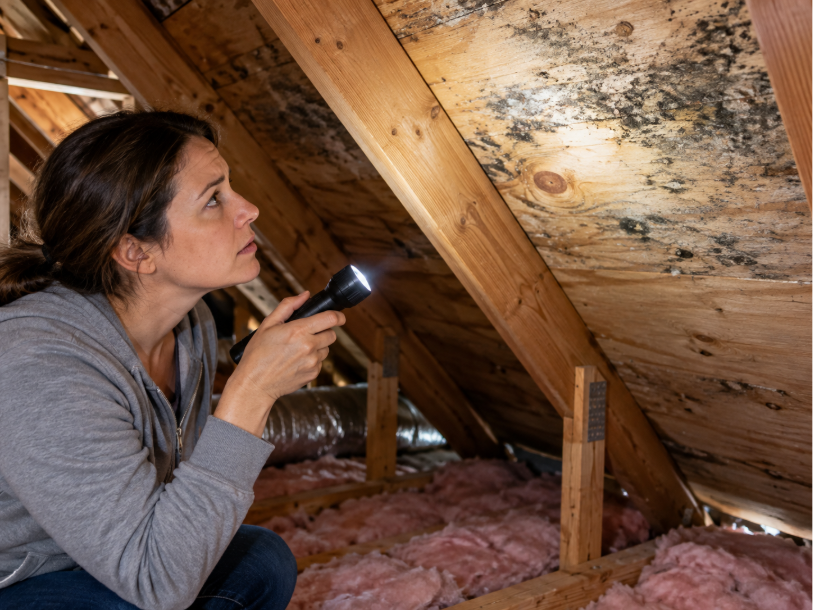
How Hidden Moisture Problems Lead to Mold Growth
Mold does not simply appear on its own. To grow and spread inside an attic, it needs an organic material that can support growth and a steady supply of moisture. While wood rafters, roof decking, insulation facing, and other materials provide plenty of surfaces where mold can develop, unwanted moisture must also be present. If left unaddressed, these hidden moisture issues can contribute to deterioration of your home’s structural components and affect indoor air quality. Pinpointing exactly why moisture is entering or accumulating beneath your roof is the first step toward keeping your attic dry and preventing mold growth.
Problem: Roof Leaks That Aren’t Always Easy to Trace
An active roof leak is one of the most common ways for moisture to enter an attic. Major roof issues like missing shingles, cracked flashing around chimneys, or worn seals near vent pipes can all allow rainwater to get inside. However, these leaks are not always easy to spot from the ground. Water can seep under shingles and travel along roof decking, rafters, or other structural components before becoming visible, meaning the mold may form in a different area than the original point of entry. Small or intermittent leaks can also go unnoticed for months if you do not regularly enter the attic to check for signs of moisture.
To fix this issue, the roof must be carefully inspected to locate and repair points of water entry. Repairing damaged shingles, replacing deteriorated flashing, and correcting worn seals around roof penetrations can stop additional rainwater from entering the space. While fixing the roof is a necessary step toward keeping the attic dry, repairing the leak only stops new water from getting in. It will not remove mold growth that has already developed on attic materials.
Problem: Condensation Across Cold Attic Surfaces
Roof leaks are not the only way for moisture issues to develop in an attic. Condensation can also form on the cooler underside of roof decking, wood trusses, rafters, and exposed metal nails. This can happen as part of the stack effect, which carries warm, humid air upward through the home. When that air reaches colder attic surfaces during chilly weather, moisture can condense into water droplets. Because these temperature differences can affect broad areas of the attic, repeated condensation may leave materials damp across more than one location.
Resolving a condensation problem requires determining why humid air is reaching cold attic surfaces and what conditions are allowing moisture to accumulate. Depending on the cause, that may involve improving attic ventilation, air sealing, insulation, indoor humidity control, or a combination of measures. Correcting those conditions can reduce continued moisture buildup, but any mold that developed while the materials were damp must still be treated separately.
Problem: Exhaust Fans Sending Moisture Into the Attic
In many homes, kitchen and bathroom exhaust fans do not vent where they are supposed to. Instead of extending the exhaust duct all the way outdoors, improperly routed ductwork may terminate inside the attic space. Every time someone takes a hot shower, cooks a meal, or otherwise uses one of these fans, humid air can be released directly into the attic. Because most homeowners do not visit their attic regularly, a poorly routed exhaust fan can go unnoticed for a long time, continually adding moisture around nearby wood and insulation.
To fix this problem, the exhaust fan ducts need to be properly rerouted so they discharge outdoors through the roof or an exterior wall. Insulated ductwork may also help reduce condensation within the duct in certain conditions. Redirecting the exhaust prevents the fan from continuing to add moisture to the attic. Any mold or moisture damage that has already developed on surrounding materials will still need to be evaluated and addressed.
Problem: Humid Indoor Air Leaking Into the Attic
Daily household activities create indoor humidity that can travel from your main living areas into the attic. This air can move through structural gaps such as openings around recessed light fixtures, unsealed electrical penetrations, plumbing penetrations, and poorly fitted attic access doors. The amount of moisture that reaches your attic depends on several factors, including indoor humidity levels, the size and number of these openings, temperature and pressure differences, and how well the ceiling is air-sealed.
Correcting this issue requires identifying and sealing the pathways that allow humid indoor air to enter the attic. Appropriate air-sealing around light fixtures, electrical and plumbing penetrations, and the attic access can reduce this airflow. Insulation or indoor humidity conditions may also need attention depending on what is contributing to the moisture problem. While air-sealing helps stop ongoing moisture transfer, mold that has already developed on attic materials still needs to be treated.
Evaluate and Correct the Cause of Attic Mold Growth
Resolving an attic mold issue is not as simple as wiping away visible dark growth on a wooden beam. If an underlying roof leak, condensation problem, improperly routed exhaust duct, or air leak remains, the attic may continue to provide the damp conditions mold needs. For homeowners dealing with these issues, professional attic mold removal in Auburn, MA, can address both the existing growth and the moisture conditions that allowed it to develop.
A remediation process begins with an inspection to determine the extent of the growth and identify the contributing moisture problem. Appropriate containment is then established to help limit the movement of spores while affected materials are treated or removed. Once the existing mold has been addressed, the underlying moisture condition also needs to be corrected so the attic is not left with the same conditions that supported the growth.
Get the Right Help for Your Attic Mold Problem
Allowing a hidden moisture problem to remain in your attic can contribute to deterioration of wood, damaged insulation, and more extensive repairs over time. Addressing excess moisture and existing mold together can help limit how much of your attic becomes affected and reduce the chance of the same conditions continuing.
Green Home Solutions provides attic mold removal in Auburn, MA, with personalized solutions based on the conditions we find inside the space. Our trained technicians assess the extent of the growth, identify contributing moisture problems, establish appropriate containment, and treat affected materials using methods suited to the surfaces involved.
If you have discovered mold or have persistent moisture in your attic, contact our team today for help identifying and resolving the entire problem, from the moisture source to the growth itself.