
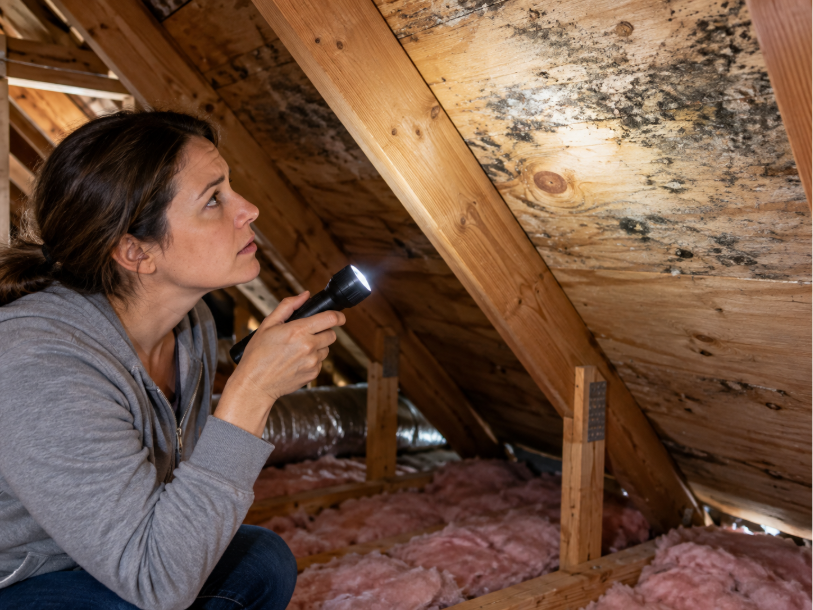
The Common Moisture Issues Behind Attic Mold
Mold doesn’t start growing on its own. To develop, it requires moisture and a material that can support growth. Inside a typical attic, surfaces such as rafters, trusses, roof decking, insulation facing, and accumulated dust can provide those materials.
Unwanted moisture can enter or accumulate in an attic in several different ways. Whether you are trying to prevent future problems or dealing with existing growth, the source of excess moisture needs to be identified and addressed to help keep your attic dry.
Water Intrusion From Damaged Roof Materials
An active roof leak is one of the more straightforward ways for moisture to enter an attic. Common roof issues such as missing shingles, cracked flashing around chimneys, or worn seals around plumbing vents can all allow rainwater to seep inside. However, these leaks are not always obvious. Water can travel along roof decking, rafters, or other structural components before becoming visible, meaning mold may not appear directly beneath the original point of entry.
Small or intermittent leaks may also go unnoticed if your attic is not inspected regularly. While repairing the roof issue is an essential step in resolving the moisture problem, fixing the leak will not address mold growth that has already developed on attic materials.
Condensation Across Cooler Attic Surfaces
Roof leaks are not the only way moisture problems can develop in an attic. Condensation can also form on the underside of roof decking, rafters, exposed nails, and other cooler surfaces. The stack effect can carry warm, humid air from your living spaces upward, where some of that air may enter your attic through openings in the ceiling. When it reaches colder attic surfaces, moisture in the air can condense.
This is especially common during colder months, when the temperature difference between your living space and attic is greater. Repeated condensation can keep materials damp long enough for mold to develop, and because it may occur across multiple surfaces, the resulting growth can affect broader areas of your attic rather than a single isolated location.
Improperly Routed Kitchen and Bathroom Exhaust Fans
In some houses, kitchen and bathroom exhaust fans do not vent where they are supposed to. Instead of directing humid air outdoors, improperly routed exhaust ducts may terminate inside the attic. Every time one of these fans runs, additional moisture is released into the space.
Because most homeowners do not regularly visit their attic, an improperly routed exhaust fan can go unnoticed for an extended period. Over time, the added humidity can contribute to damp conditions on nearby roof decking, framing, or insulation and create an environment that supports mold growth.
Indoor Humidity and Air Leakage From Below
Daily indoor activities can create humidity that moves from your main living spaces into your attic. Air can pass through structural openings such as gaps around recessed light fixtures, unsealed electrical or plumbing penetrations, and poorly sealed attic access doors.
The amount of moisture that reaches your attic depends on several factors, including indoor humidity levels, the number and size of these openings, and pressure differences within the home that influence airflow. Identifying and appropriately air-sealing these pathways can be an important part of reducing the amount of warm, humid air entering your attic.
Why Addressing Moisture Is Necessary to Fix the Problem
To fully address attic mold, the moisture source must also be identified and corrected. Simply cleaning visible growth from the wood will not resolve the issue if a roof leak, condensation, ventilation problem, air leakage, or another source of excess moisture remains. Professional attic mold removal in Danbury, CT, can address the existing growth while also evaluating the conditions that allowed it to develop.
A proper remediation process begins with an inspection to determine the extent of the growth and identify contributing moisture conditions. Appropriate containment is then established to help limit the movement of spores while affected materials are treated or removed. Damaged materials may need to be replaced, and the underlying moisture problem should also be corrected so your attic is not left with the same conditions that supported the mold.
Take Action to Protect Your Attic Today
Leaving an attic moisture problem unresolved can allow mold to spread across additional materials and can contribute to deterioration of roof decking, rafters, framing, or insulation over time. Addressing both the mold and the moisture behind it can help limit how much of the attic becomes affected and reduce the need for more extensive remediation or repairs later.
Green Home Solutions provides attic mold removal in Danbury, CT, with solutions based on the conditions found inside your attic. Our trained technicians assess the extent of the growth, identify contributing moisture problems, establish appropriate containment, and treat affected materials using methods suited to the surfaces involved.
If you have found mold, staining, or persistent moisture in your attic, contact us today to schedule an evaluation and get clear recommendations for addressing both the existing growth and the conditions that allowed it to develop.