
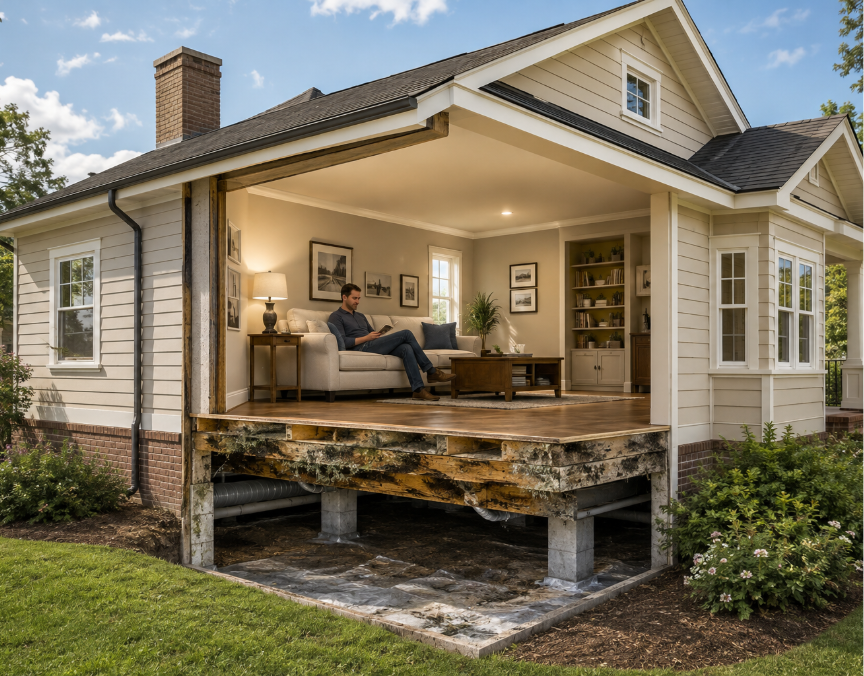
Your crawl space and the rest of your home are more closely connected than their physical separation might suggest. Moisture beneath your house can create conditions for mold growth, and the resulting problem isn’t necessarily confined below your floors. Spores can reach your living areas, while continued dampness can affect insulation, attract pests, and contribute to deterioration of floor joists and supports. Because of these connections, removing mold from a crawl space can help protect both the area where the problem began and the rest of your home.
How Does Crawl Space Mold Develop?
You don’t need a major flood or plumbing failure for mold to develop beneath your home. A crawl space can become consistently damp through smaller, ongoing sources of moisture, including water vapor rising from a bare earth floor or humid outdoor air entering through foundation vents. Poor drainage around your foundation, a dripping pipe, or a leaking HVAC condensation line can introduce additional water.
These moisture sources become a mold problem when damp conditions persist. Airborne mold spores that settle on wood, paper-faced insulation, dust, or other organic material can begin growing when moisture, oxygen, and favorable temperatures are present. Humidity above 60% can help sustain these conditions, and when surfaces remain wet, mold growth can begin within 24 to 48 hours.
Can Crawl Space Mold Get Into the Rest of My Home?
Your crawl space is separated from your living areas by the subfloor, but air can still move between the two. Small openings around pipes, wiring, and HVAC components provide pathways for crawl space air to enter the rooms above. Ductwork running through a damp crawl space can also draw in mold spores if it has leaks or isn’t properly sealed, providing another way for them to circulate throughout your home.
The stack effect increases this movement by drawing air from beneath your floors as warmer air rises through your home. Depending on the structure and conditions, crawl space air can account for roughly 40% to 60% of the air entering your living areas, bringing humidity, odors, gases, and mold spores with it. Signs that crawl space conditions are affecting your living areas can include musty smells near lower levels or vents, higher indoor humidity, and changes such as warped flooring. Allergy symptoms, coughing, or asthma that becomes worse indoors can provide another reason to investigate what’s happening beneath your home.
What Are the Risks of Crawl Space Mold?
Crawl space mold can create several problems at the same time. Because air moves from beneath your floors into your living areas, mold spores can become an indoor air quality issue rather than remaining isolated below. Exposure can contribute to sneezing, coughing, irritated eyes or throats, and other allergy symptoms, and it can aggravate asthma in people who are sensitive to mold. Musty odors and increased humidity can also affect how comfortable your home feels.
Below your floors, persistent dampness can allow deterioration of wooden floor joists and subflooring to progress, potentially affecting the floors they support. Moist conditions can also make your crawl space more attractive to termites and rodents. Prompt crawl space mold treatment helps address the growth before these effects have additional time to develop, protecting your indoor environment and the condition of your home.
How Can Crawl Space Mold Be Resolved?
Before mold is removed, it’s important to determine why your crawl space became damp enough to support growth in the first place. A plumbing leak, drainage problem, groundwater, or excessive humidity can continue supplying moisture until the underlying issue is corrected. Addressing that source is an important part of crawl space mold removal in Glastonbury, CT.
From there, mold removal in a crawl space focuses on physically removing the growth and addressing affected materials throughout the area. Some crawl spaces also require ongoing humidity control after treatment. When necessary, solutions such as dehumidification, vapor barriers, or encapsulation can help prevent excess moisture from creating favorable conditions for mold again.
Keep Crawl Space Mold From Becoming a Whole-Home Problem
What begins beneath your floors can eventually affect your living areas, indoor air, and structural materials. Once crawl space mold develops, correcting the moisture problem and removing the growth can help limit how far those effects extend throughout your home.
Green Home Solutions provides crawl space mold removal in Glastonbury, CT, as part of a comprehensive approach to mold and moisture problems. Through a detailed crawl space inspection, we can evaluate the growth, identify contributing conditions, and determine whether additional moisture-control measures are appropriate after treatment. If musty odors, elevated humidity, flooring changes, or other signs have raised questions about your crawl space, bring those questions to Green Home Solutions and let us help you determine the right next step.