
Your home isn’t a single environment. Different rooms, different levels, and different corners of the same property can all experience moisture very differently depending on how the home is used, how it’s built, and how air moves through it. That variation matters, because mold doesn’t develop randomly. It shows up where conditions favor it, and those conditions almost always involve moisture that has had time to sit.
Getting familiar with the areas where mold most commonly develops can help you catch problems earlier and recognize when mold remediation in Malden, MA, may be the right next step.
Bathrooms
It’s no surprise that bathrooms make this list. Between daily showers, steam that travels to every surface in the room, and water that splashes beyond the tub or shower, bathrooms are dealing with moisture on a constant basis. What makes them especially prone to mold is what happens after the water stops. If a bathroom doesn’t have good ventilation, humid air lingers and settles onto walls, ceilings, grout lines, and trim. That repeated cycle of moisture with nowhere to go is exactly what mold needs to get established.
Kitchens
Kitchens see a lot of water activity, and much of the plumbing that supports it is hidden from view. The area under the sink, the space behind the refrigerator, and the cabinetry around a dishwasher are all spots where a slow drip or failing connection could be adding moisture to surrounding materials without anyone realizing it. Because these spaces aren’t part of regular daily observation, a minor plumbing issue can quietly create damp conditions that persist long enough for mold to develop.
Basements
Basements have a different relationship with moisture than the floors above them. They sit at or below ground level, which means foundation walls are in regular contact with soil that holds water. That moisture can work its way through concrete and contribute to higher humidity levels in the space overall. Basements also tend to function as storage areas, which means belongings can sit undisturbed for long periods while damp conditions affect them from the outside. Without consistent attention, the signs of a growing moisture problem can be easy to miss.
Attics
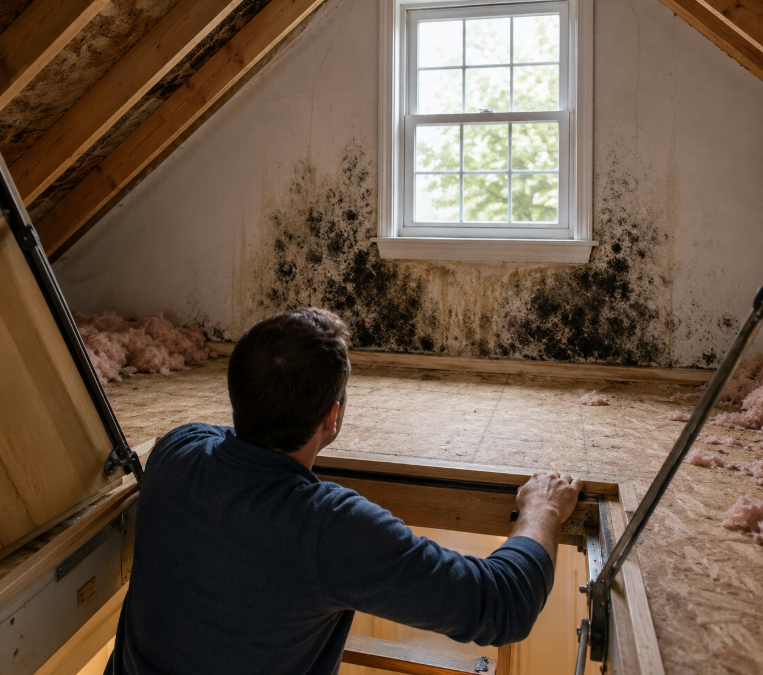
Most people don’t spend much time in their attic, which makes it one of the easier places for a mold problem to go unnoticed. Attics are exposed to moisture from two directions: water can get in through small roof issues like worn shingles or flashing that has started to separate, and condensation can form when warm air from inside the home rises and meets the cooler surfaces overhead. Either way, the insulation and wood framing up there can stay damp longer than you might expect, and mold can spread across those materials before there’s any visible sign of a problem from below.
Crawl Spaces and Concealed Areas
Crawl spaces sit close to the ground and often have limited airflow, which makes them naturally prone to holding onto moisture. Ground humidity alone can be enough to create persistently damp conditions in these spaces. The same general problem can occur inside wall cavities or beneath flooring materials, where a leak or absorbed moisture has no easy way to escape. These are the kinds of areas where mold can be actively growing without any outward indication that something is wrong.
What to Do When You Find Mold
Spotting mold raises some reasonable questions. How long has it been there? Is the moisture source still active? Is there more that isn’t visible yet? Cleaning up what you can see doesn’t answer any of those questions, and it doesn’t solve the problem if the underlying cause is still present. Getting a clear picture of what’s going on requires looking at both the mold itself and the conditions that allowed it to develop. That’s the only way to address the situation in a way that actually sticks.
If you’ve found mold in your home and need mold remediation in Malden, MA, Green Home Solutions is here to help. Our team can inspect your property, identify where the moisture is coming from, and recommend the right course of treatment for the affected areas. Contact us today to schedule an inspection.