
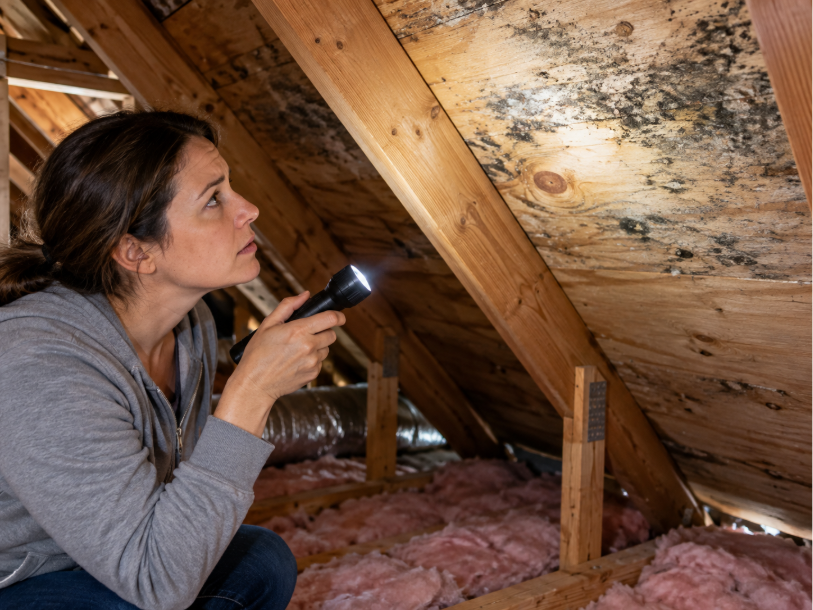
How Moisture Problems Turn Into Attic Mold
An attic can provide many of the materials mold needs to grow, including roof decking, rafters, framing, insulation facing, and accumulated dust. Mold spores are naturally present in any environment, but growth only begins when spores reach an organic surface that remains damp long enough to support it.
Excess moisture can enter or accumulate in your attic through several different pathways. Because the source may not always be obvious, determining where that moisture is coming from is a necessary step in controlling it. Addressing the cause can help prevent mold from developing in the first place or keep the same conditions from continuing after remediation.
Water Intrusion From the Roof Can Affect the Attic
When roofing materials fail, moisture can enter your attic and remain in contact with wood, insulation, and other building materials. Missing or damaged shingles, deteriorated flashing, worn seals, and problems around roof vents or other penetrations are all possible sources of water intrusion.
The location of the leak and the location of the resulting mold are not always the same. Water can travel across roof decking or along rafters before settling in another area, which can make the original source harder to identify. Intermittent leaks may also escape notice if your attic is rarely visited.
If affected materials stay damp, mold can begin to develop. Repairing your roof problem helps prevent more water from entering, but it does not address mold growth that has already formed on attic surfaces.
Condensation Can Affect Large Areas of an Attic
A roof leak is not required for attic materials to become damp. Warm, humid air can move upward from your living space as part of the stack effect and enter the attic through openings in the ceiling. When that air reaches colder roof decking, rafters, nails, or other surfaces, moisture can condense.
Repeated condensation can gradually leave attic materials damp enough to support mold growth. Since temperature differences can affect broad sections of the space, condensation may form in multiple areas at the same time, increasing the chance that mold will develop across more than one part of your attic.
When Household Exhaust Air Ends Up in the Wrong Place
Kitchen and bathroom exhaust fans are intended to move moisture out of your house. When the ductwork is improperly routed into the attic, however, that moisture is simply transferred to another part of your home.
Every use of the fan can add humid air to your attic, increasing the chance that surrounding materials will remain damp. Because these ducts are typically hidden from view, the problem may not become apparent until someone enters your attic and notices moisture, staining, or mold nearby.
Where Humid Indoor Air Can Enter the Attic
Moisture can reach your attic without a roof leak or exhaust problem. Humid air from your living space may pass through openings around attic hatches, ceiling fixtures, pipes, wiring, ductwork, and other penetrations between the house and attic.
How much moisture moves through these pathways depends on the humidity inside your home, the number and size of the openings, and differences in temperature and air pressure. Identifying and sealing the relevant air leaks can help reduce the amount of moisture entering your attic and improve overall moisture control.
Fix the Moisture Conditions as Part of Attic Mold Remediation
Professional attic mold removal in North Kingstown, RI, involves more than removing visible growth. The source of excess moisture also needs to be located and corrected so your attic is not left with the same conditions that allowed the mold to develop.
After the extent of the growth is evaluated, the affected area can be contained and mold can be treated or removed from the materials involved. Damaged materials may require replacement, and the underlying moisture issue, such as a roof leak, condensation, or air leakage, should be addressed as part of the remediation process.
Get Help Resolving Attic Mold and Its Moisture Source
Attic mold can develop when water enters through damaged roofing, condensation repeatedly dampens materials, humid exhaust air is released into the attic, or moisture travels upward from your living space. No matter how the moisture gets there, addressing its source is necessary alongside remediation of the existing growth.
Green Home Solutions provides attic mold removal in North Kingstown, RI, with solutions developed around the specific conditions affecting your attic. We can determine how extensive the growth is, identify contributing moisture conditions, establish containment, and treat the affected materials using an appropriate remediation plan.
Contact us today to schedule an attic inspection and start addressing mold growth and moisture conditions together.