
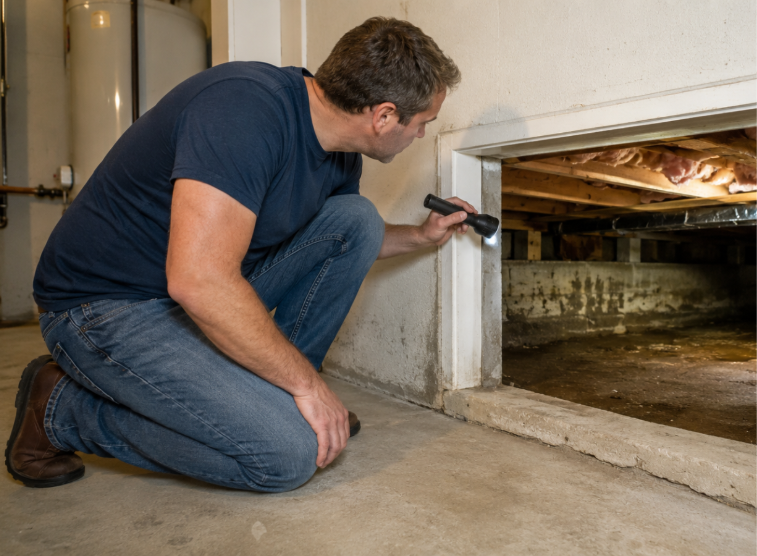
Did you know a space you rarely enter can influence the air quality throughout your home? Your crawl space can play an important role in your indoor air. A physical process known as the stack effect is largely responsible: as warm air rises through your home, it draws air upward from lower levels, including the crawl space, carrying moisture, mold spores, gases, and other airborne substances with it. When mold is present in the crawl space, this air movement can carry spores into the living areas above, allowing the effects of the problem to extend beyond where the mold initially developed.
How Does Crawl Space Mold Go Unnoticed?
Crawl spaces are practically designed to be overlooked. They’re dark, separated from your everyday living areas, and often have limited ventilation, so most homeowners have little reason to check them regularly. As a result, excess moisture and elevated humidity can persist without being detected, creating conditions where mold can develop on subfloors, floor joists, and other materials. By the time signs of a problem become noticeable upstairs, mold may have been growing beneath the home for some time.
What Are the Signs There May Be Mold Beneath My Home?
Crawl space mold has a way of announcing itself indirectly, even when it stays out of view. A musty odor that keeps coming back upstairs, allergy or asthma symptoms that seem to flare up more than usual, floors that feel spongy or look uneven, and humidity in your home that’s higher than it should be can all indicate a problem beneath your house. If you are able to look inside your crawl space directly, patches of white, green, or black growth on the joists, insulation, or ductwork are a strong indication that mold has already established itself.
How Do I Confirm Mold in My Crawl Space?
Suspecting mold in your crawl space is different from confirming that it is actually present. A professional inspection, along with mold and air quality testing, can help determine whether mold is present, how extensive the growth is, and whether it is affecting the air inside your home. If you just do a quick visual check yourself, you could miss growth in areas that are difficult to access or see clearly, which is why a professional evaluation provides a more reliable understanding of the conditions beneath your home.
What Should I Do if Mold Is Confirmed?
If an inspection confirms mold, professional crawl space mold removal in Greensboro, NC, is the appropriate next step rather than a DIY treatment. Store-bought products and home remedies typically address only visible growth and can miss mold in areas that are difficult to reach. They also don’t resolve the moisture conditions that allowed the mold to develop, increasing the likelihood that the problem will return.
Professionally removing mold from a crawl space addresses the existing growth as well as the conditions contributing to it. Depending on the source of the moisture, crawl space encapsulation may also be recommended. Encapsulation helps separate the crawl space from outside moisture and air, reducing conditions that can support future mold growth.
Take Control of the Air Beneath Your Home
Mold in your crawl space isn’t always visible from where you’re standing, but due to the stack effect, it can still have a real impact on the air quality throughout the rest of your home. Paying attention to warning signs like musty odors or uneven flooring is a good starting point, but only a professional inspection can tell you for certain what’s actually happening below.
Green Home Solutions offers mold removal for crawl spaces throughout the Greensboro area, addressing both the mold itself and what’s causing it to grow. From inspection and testing to crawl space mold removal in Greensboro, NC, and encapsulation when it makes sense, we manage the entire process from start to finish.
Curious what’s really going on beneath your home? Reach out to Green Home Solutions and schedule a crawl space inspection to find out.